Originally published in Dee Maddox’s D.E.E.D.® Dynamics newsletter on October 29, 2026. Reposted with the author’s permission.
Subscribe to our LinkedIn Newsletter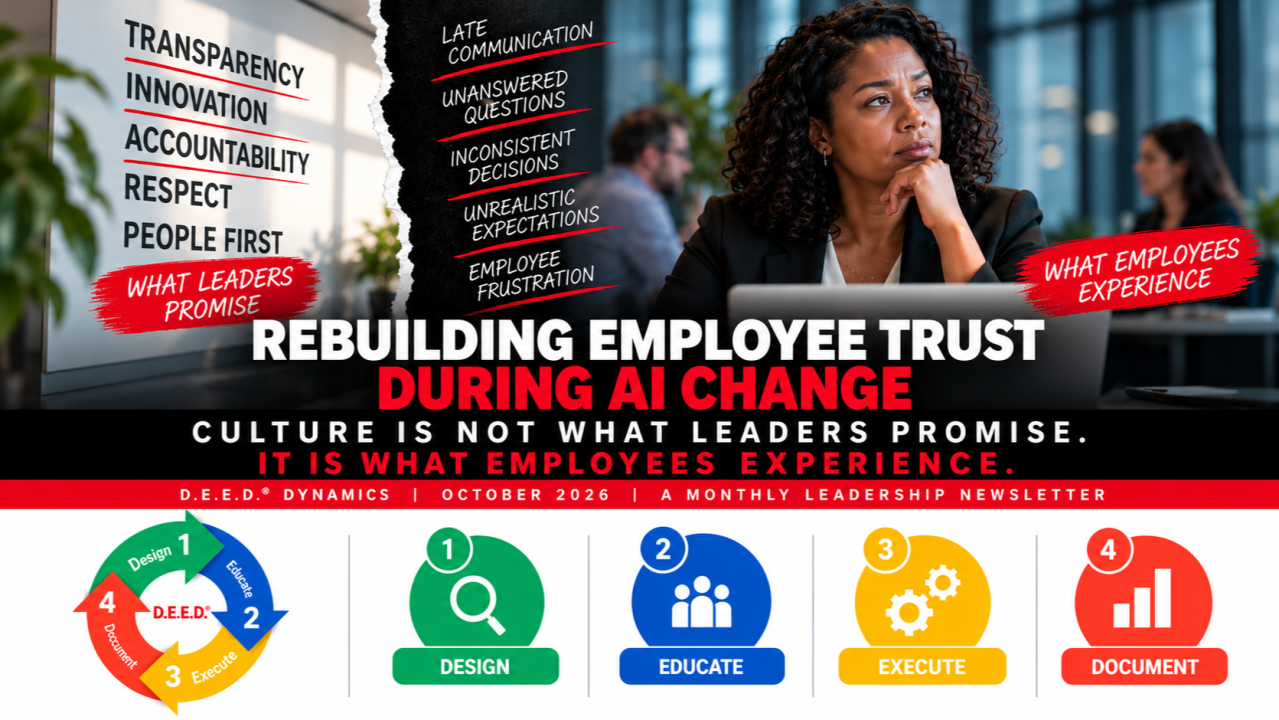
The motivational posters on your walls make a promise. Your leaders decide every day whether employees see that promise kept.
When those promises and daily experiences do not match, trust begins to erode. Employees question decisions, stop sharing ideas, and sometimes start looking for the exit.
Earlier this month, I explored this challenge with HR professionals at the HRSouthwest Conference in Fort Worth during my session, Cultural Debt Audit: Rebuilding Trust in AI Workplaces.
My message was simple: Culture grows one leader at a time. Leadership owns the gap between what organizations say and what employees experience.
This gap is cultural debt.
Like financial debt, cultural debt accumulates when promises go unmet. The longer leaders ignore it, the more difficult it becomes to rebuild confidence.
AI is making these gaps more visible. As technology changes how work gets done, employees are watching how leaders communicate, make decisions, and respond to concerns.
This month, I challenge you to identify one gap between what your organization promises and what employees experience.
Then do something about it.
Inside This Issue
- The Problem: How cultural debt builds in daily decisions
- The Solution: Four leadership behaviors that strengthen trust
- The Action: Apply D.E.E.D.® to conduct a cultural debt audit
The Challenge: When Promises and Practices Do Not Match
Most organizations have values that sound good on paper.
Transparency. Accountability. Innovation. Respect.
But what happens when employees experience something different?
- A company promotes transparency, yet employees learn about important decisions after they are made.
- Leaders encourage innovation, yet questions about new technology are treated as resistance.
- An organization celebrates accountability, yet commitments are rarely revisited.
Each situation may seem small. Together, they shape what employees believe about leadership.
When employees stop asking questions, sharing ideas, or trusting decisions, organizations lose more than goodwill. They lose opportunities to improve performance, solve problems, and retain talent.
That is the cost of cultural debt.
Why This Matters
Employee trust influences how people communicate, collaborate, and respond to change.
Gallup's research has consistently identified the person leading a team as a major influence on employee engagement. Its widely cited 2015 analysis estimated that managers account for at least 70% of the variance in engagement across business units.1
That finding is a reminder of the influence leaders have on the daily employee experience.
Research by Amy Edmondson also connects psychological safety with team learning. When employees believe they can ask questions, acknowledge mistakes, and raise concerns without being embarrassed or punished, they are better positioned to learn together.2
These findings do not mean every engagement or performance problem begins with leadership. They do reinforce why leadership behavior deserves close attention.
Now add AI to the equation.
Imagine an organization introducing a new AI tool with the promise of reducing administrative work. Three months later, the old reporting requirements remain, and employees have another system to manage.
The technology changed. The workload did not.
If leaders dismiss concerns or fail to explain what comes next, employees may begin questioning whether the promised benefits were ever intended for them.
The issue is no longer just technology adoption. It is trust.
The Problem: Cultural Debt Builds in Daily Decisions
Cultural debt is the accumulated cost of organizational promises that are not reflected in everyday decisions and behavior.
It rarely begins with one dramatic event. More often, it develops through repeated experiences:
- Employees raise concerns but never hear what happened next.
- Leaders ask for feedback but make decisions without acknowledging it.
- Accountability depends on who made the mistake.
- New processes are introduced without removing outdated work.
- Employees remain silent because previous conversations produced no change.
One quiet meeting does not prove that employees lack trust. But repeated silence, particularly after concerns have gone unanswered, deserves attention.
Over time, employees learn what is rewarded, what is ignored, and whether speaking up makes a difference.
Culture is shaped by what leaders do and experienced by the people they lead.
The Solution: Make Trust Visible
Trust is rebuilt through more than another campaign, slogan, or town hall. It grows when employees experience consistent leadership behavior.
Start with FOUR practices.
1. Explain decisions.
Employees may not agree with every decision, but they deserve to understand the reasoning. Explain what is changing, why it matters, and what remains uncertain.
2. Make room for disagreement.
Invite questions and different perspectives. Listen without immediately defending the decision. People are more likely to contribute when they believe their input will be taken seriously.
3. Follow through on commitments.
Acknowledge what was promised. Report progress, explain delays, and close the loop. When circumstances change, communicate what changed and why.
4. Examine the human impact of technology.
Before celebrating efficiency, ask how a new tool affects workloads, responsibilities, decision-making, and the employee experience.
These behaviors are straightforward. Practicing them consistently requires intention and accountability.
Start with one gap employees can recognize. Address it before launching another culture initiative.
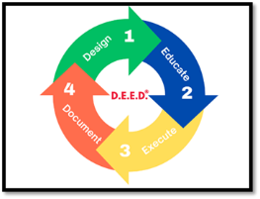
The ACTION: Apply the D.E.E.D.® Framework
The D.E.E.D.® Framework provides a practical way to move from identifying cultural debt to addressing it.
Design
- Identify one organizational promise that is not consistently reflected in employee experiences, such as transparency, accountability, or respect.
- Ask employees what that value looks like in daily work and where their experiences fall short.
- Define one observable leadership behavior that would demonstrate the promise in action.
The Question: "What should employees see leaders doing differently?"
Educate
- Equip leaders to recognize the gap between their intentions and employees' experiences.
- Practice asking open questions, listening without defensiveness, and explaining decisions.
- Discuss how to respond when employees challenge a process, question an AI tool, or identify a broken commitment.
The Question: "Do leaders know how to demonstrate the behavior we expect?"
Execute
- Commit to one visible improvement within 30 days.
- Clarify decision authority, respond to employee suggestions, eliminate duplicate work, or create regular opportunities to discuss how technology affects people.
- Give the action an owner and a deadline.
The Question: "What will change in the way work gets done?"
Document
- Track the concern, the commitment, the action taken, and the results.
- Follow up with employees to determine whether they notice a difference. Review indicators such as unresolved concerns, decision clarity, and progress on commitments.
- Document what worked, what needs adjustment, and which leadership behaviors must continue.
The Question: "What evidence shows that employees are experiencing the change?"
A completed action is progress. A sustained improvement in employee experience is the goal.

O.W.N. IT!
Leadership accountability begins with ownership.
Outline: Identify the cultural gap, define the desired behavior, and clarify responsibility.
Work the Plan: Put the behavior into practice through everyday conversations, decisions, and commitments.
Navigate: Invite feedback, address obstacles, and adjust when employees' experiences do not match leadership's intentions.
Trust takes time to rebuild. Consistency gives employees a reason to believe the change is real.

Did You Know?
Psychological safety and accountability can exist together.
Psychological safety is a shared belief that people can take interpersonal risks at work, like asking questions, raising concerns, or admitting mistakes.2 It goes hand in hand with hard conversations and high performance standards.
Leaders can expect excellent work and still build a place where people feel free to speak honestly. Honest talk often makes accountability stronger, since teams can fix problems while they are still small.

Quick Win
At your next team meeting, ask:
"Where is the biggest gap between what we say matters and what our team actually experiences?"
Then listen. Resist the urge to explain, defend, or immediately solve the problem.
Choose one concern you can address within two weeks. Communicate the next step, identify who owns it, and report back.
Even when the issue cannot be resolved immediately, employees should know their concerns were heard and what happens next.
Trust grows when people see what happens after they speak.
Build Trust Where Work Happens
Is your organization introducing new technology, navigating change, or struggling to close the gap between its values and what employees experience? The first step is identifying where leadership practices no longer match organizational promises.
DMX Consulting partners with organizations to make those gaps visible and equip leaders to address them.
Ready to strengthen leadership accountability and rebuild trust?
Book a risk free consultation with DMX Consulting to discuss leadership development and practical strategies for your organization.