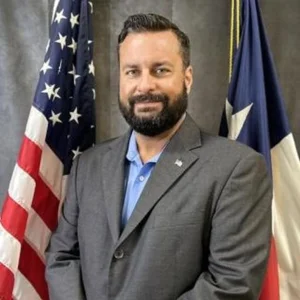
Dr. Wes Blair on airport policing, leadership, and taking care of the people who serve
Most people think they understand police work until the job moves into an airport.
An airport is almost like a city where nobody lives, everyone is in a hurry, half the rules come from somewhere else, and the police still have to make it all work.
That was the starting point for this episode of The Clear Voice with Dr. Wes Blair, Chief of Police at Memphis International Airport. Wes joined James Groom for a conversation about his law enforcement career across multiple states, the move from traditional municipal policing into airport law enforcement, and why wellness has to start at the top.
Airport policing is still police work, but the environment changes everything
Wes began his career in Lancaster, Texas, the community where he grew up. Like many officers, he was first drawn to the excitement of the job. But early in his career, a call with an elderly resident helped shape how he viewed policing.
She felt safer not simply because a police officer had arrived, but because someone from her community was there. That moment helped reinforce for Wes that policing depends on relationships, trust, and the consent of the community.
That same belief followed him through his work in Lancaster, his time as Chief of Police in Cape Girardeau, Missouri, and eventually into his current role at Memphis International Airport.
But airport policing added a new layer.
At Memphis International Airport, the work is still law enforcement. Officers enforce state law, handle calls, take reports, conduct traffic enforcement, and serve in specialized functions. But they also operate in an environment shaped by aviation security, federal regulation, TSA and FAA requirements, airport operations, tenants, airlines, travelers, cargo, and customer service expectations.
Wes explained that airport police also carry a security role tied to protecting critical infrastructure. That means some responsibilities may not look like traditional police work at first glance, but they are essential to the larger mission.
That shift requires leaders to listen, learn, and understand the environment before making changes.
Listen first, then lead
One of the strongest leadership lessons from the episode was simple: do not walk into a new organization assuming you already know what needs to change.
Wes said every community has its own culture and dynamics. That applies whether the community is a city, a police department, or an airport. Leaders who arrive with all the answers on day one are likely to miss what is already working, misunderstand what needs to change, and damage trust before they have earned it.
That does not mean leaders should ignore serious problems. But it does mean they should take time to understand the organization, the people, the structure, and the reason things operate the way they do.
In airport policing, that lesson became even more important. The reporting structure is more layered than a traditional municipal police department. Decisions often involve multiple divisions and leaders because airport operations are interconnected. Police, fire, emergency management, communications, safety, maintenance, terminal operations, and other functions all affect each other.
For local government leaders, that is an important reminder. Police departments, fire departments, public works, utilities, finance, human resources, and administration may have different responsibilities, but they are all part of the same mission.
Strong leadership requires relationships across the organization, not silos.
Wellness became personal
The conversation then turned to officer health and wellness.
Wes spoke openly about his own experiences working crimes against children and the impact that work had on him. Like many officers from that era, he did not feel comfortable telling a supervisor he was struggling. He also did not trust that seeking help through an employee assistance program would remain truly separate from the organization.
So he sought counseling privately.
Years later, after seeing officers struggle through traumatic events, Wes began to see wellness not as a side issue, but as a leadership responsibility.
His view is clear: a mentally healthy police officer is better for the officer, better for the officer’s family, and better for the community. Officers who are not well are still expected to respond to people on their worst days. If organizations do not help them process what they carry, the consequences eventually show up at work, at home, and in the community.
At Cape Girardeau, Wes and his team helped build a wellness conference focused on first responders and their families. They also worked to make the conference affordable so smaller agencies could participate. That mattered because officers in small departments experience trauma too, even when their agencies do not have large training budgets.
The department also implemented annual mental health check-ins for officers. Each officer met with a culturally competent mental health professional once a year. The department paid for it, and the only thing reported back was whether the officer attended.
They could talk about trauma, stress, baseball, or nothing at all.
The point was to normalize support before someone reached a breaking point.
Put your mask on first
The title of Wes’s article for Clear Career Professionals, “Authentic Leadership: Taking Care of Ourselves,” connects directly to the familiar airplane safety reminder: put your own oxygen mask on before helping someone else.
That message matters for public safety leaders, city managers, department heads, and anyone responsible for leading people through pressure.
Leaders cannot ask their teams to take wellness seriously if they refuse to model it themselves. They cannot build healthy organizations while pretending they are immune from stress, trauma, burnout, or isolation.
Wes was honest that this is still an area where he continues to grow. He said the article was not just written for an audience. In many ways, he wrote it for himself.
That honesty is part of the message.
Self-care is not weakness at the top. It is part of authentic leadership.
For chiefs and executives, the options for support may look different. A police chief cannot always turn to someone inside the department the same way a line officer might. A city manager may carry pressure that employees never see. Department heads may absorb conflict from elected officials, employees, residents, and organizational crises all at once.
But the need for support does not disappear because someone has a title.
A conversation for all local government leaders
This episode is about airport policing, but the message reaches much further.
It is for police chiefs trying to build healthier departments.
It is for city managers who carry pressure from every direction.
It is for fire chiefs, department heads, supervisors, HR leaders, and public servants trying to create organizations where people can do hard work without being quietly crushed by it.
The work of local government is people work. It depends on trust, relationships, service, and leadership. If the people doing that work are not healthy, the organization will eventually feel it.
Wes’s advice near the end of the episode was practical: start your day calm. Do not immediately run into emails, messages, and overnight problems. Not everything is a crisis, and leaders have to know the difference between what is urgent and what is truly important.
That may sound simple, but simple does not mean easy.
It is a reminder that leadership starts before the first meeting, before the first call, and before the first crisis of the day.
Sometimes it starts with taking a breath, putting your mask on first, and making sure you are healthy enough to help the people depending on you.
Read Wes Blair’s article, “Authentic Leadership: Taking Care of Ourselves”:
https://clearcareerpro.com/clear-news/authentic-leadership-taking-care-of-ourselves
Learn more about Wes and Blair Advisor Group:
https://blairadvisorgroup.com/
Connect with Wes on LinkedIn:
https://www.linkedin.com/in/wes-blair/
About The Clear Voice Podcast
The Clear Voice is a dedicated platform for transparency and expert led dialogue within the professional and public sectors. The show serves as a vital resource for leaders who want to move past surface level discussions and dive into the real world mechanics of governance, management, and organizational growth. James Groom is the host of the program.
About Clear Career Professionals
Clear Career Professionals is a specialized recruitment and strategic consulting firm focused on the public sector. We believe that the strength of any municipality or school district lies in the quality of its leadership and the cohesion of its teams. Our team is comprised of former practitioners and retired executives who understand the nuances of public service. We provide organizations with more than just a list of candidates; we provide the strategic oversight and expertise necessary to navigate transitions, maximize taxpayer funds, and implement long term solutions.
Connect With Us
Visit our official website to explore current job opportunities or to learn more about our leadership services: clearcareerpro.com.
Follow us for more updates:
Career Opportunities: https://clearcareerpro.com/career-opportunities/
Recruitment Services: https://clearcareerpro.com/recruitment/
Services: https://clearcareerpro.com/all-services/
Clear News:https://clearcareerpro.com/clear-news
The Clear Voice Podcast: https://clearcareerpro.com/the-clear-voice/
LinkedIn: https://linkedin.com/company/clear-career-pro
Facebook:Clear Career Professionals @ClearCareerPro