A great Owner’s Rep is not a side of the table. They’re the connective tissue between every side of it.
I’ve been an Owner’s Rep for over 7 years now. Before that I spent about 8 years on the subcontractor side. I’ve sat in the GC trailer, in the design conference room, across from the owner, and at the planning table with the trade foremen. The job isn’t about loyalty to any one seat. It’s about making sure the project works for everyone sitting in them.
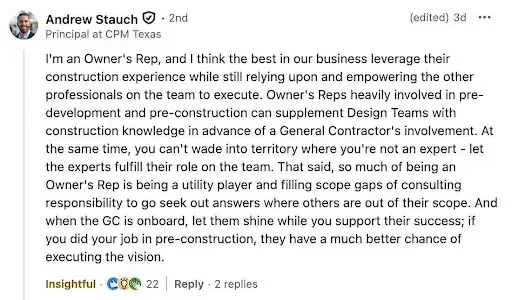
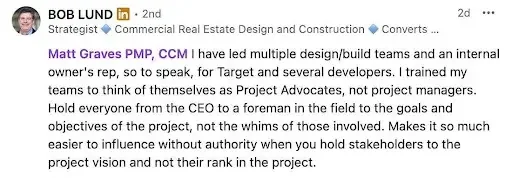
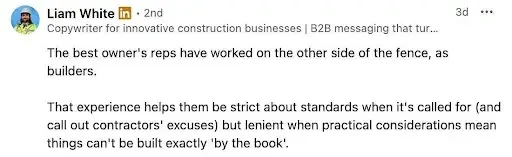
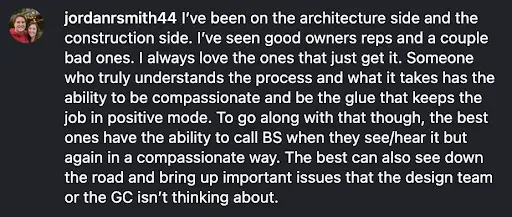
Last week, I asked my social media followers what makes a great Owner’s Rep. A pattern emerged fast: the people who value Reps the most are the ones who’ve worked with good ones from every seat. The best compliments came from the people a bad Rep would have put on the other side of the table.
Here’s what a great Owner’s Rep looks like for each stakeholder. The common thread is simple. You have to learn to speak their language.
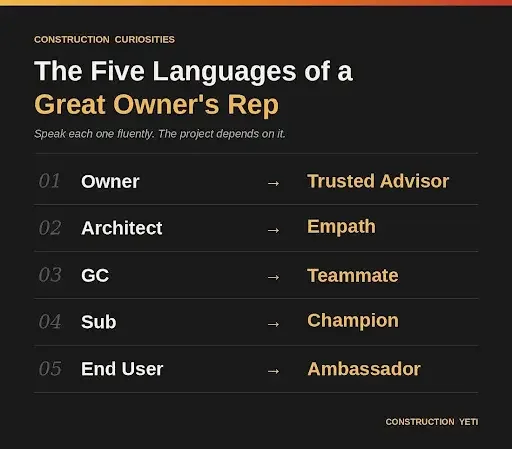
To the Owner: Be the Trusted Advisor They Need Today
Picture a school district superintendent sitting across from you at the kickoff meeting. She has a $180M bond in her back pocket, a school board breathing down her neck, and she has never once in her life read an AIA G702. But she’s about to oversee the largest capital program of her career.
Now, picture a pharma facilities director on the other end. Fourth building. Knows the questions to ask before you do. Already red-lined the contract before your intro call.
Same title. Two completely different jobs for you.
A great Owner’s Rep meets the owner where they are and adjusts every single time. Your job is to make sure they get what they’re paying for. Not what the design team thinks is clever. Not what the GC finds convenient. Not what a product rep pitched at a lunch and learn. What the owner actually needs, for the building they actually want, at the price they actually agreed to.
That means knowing the contract better than anyone on the project. It means flagging decisions before they drift. It means putting things in writing, promptly, so the answer can’t get remembered three different ways six months later.
Bad Reps just nod along. They agree in meetings and never surface the hard questions. They send status updates instead of recommendations.
Real trusted advisors push back with care, because the alternative is a building the owner regrets.
To the Architect: Lead With Tactical Empathy
There’s a concept in the book “Never Split the Difference” called tactical empathy. It’s the practice of deliberately understanding what the other person needs before you ever ask them for anything. It’s basically negotiation 101, and it’s stunningly underused in construction.
The design team is trying to protect something. Usually, it’s their design intent, but it’s also their scope, their liability, and their reputation on a project they’ll put on their website for the next decade. If you walk into the conversation only carrying the owner’s cost concerns, you’re going to lose the architect before you start. They’ll nod, agree to things in the room, and then the drawings will come out exactly the way they wanted anyway.
Good Reps ask the design team what matters most on this project. Is it the material palette? The ceiling plane? The way the light moves through the main lobby? Once you know what’s sacred, you can help the owner trade around it instead of stepping on it.
Bad Reps show up to design meetings with a hatchet. Good Reps show up with questions.
You also have to know the AE’s contract. Owners ask for things every day that are not in the architect’s scope. A great Owner Rep knows the line, holds it, and gets the AE paid for additional services when the owner genuinely wants to expand the ask.
To the GC: Be Part of the Team
A GC PM told me the worst Reps she ever worked with positioned themselves across the table from the GC and never moved. Posturing that added three months to precon. Fights over every pay app. Fights over every RFI. Fights over fights.
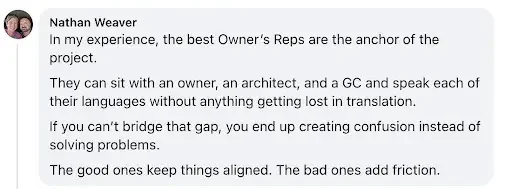
A great Owner’s Rep is not the enemy of the GC. They’re part of the team.
The fastest way to sink a project is for the Rep to turn every conversation into a battle. The next fastest way is to let decisions drift. The GC needs answers. If the owner takes two weeks to approve a finish substitution, that delay does not stay with the owner. It becomes the GC’s schedule problem, which becomes the sub’s schedule problem, which becomes everyone’s problem.
So be fast. Be clear. Put it in writing. When something is wrong, cite the paragraph in the contract and have a real conversation about it. When something is close enough, let it be close enough. Know when to be strict and know when to be practical. The GC will respect both if you’re consistent.
Bad Reps try to run the GC’s job for them. Good Reps know enough to ask good questions and recognize real answers.
To the Subs: Clear the Path, Then Protect It
Subs build the job. Every decision the rest of us make in a conference room is really a decision about whether the trades can do their work.
Managing the subs isn’t the Rep’s job. That’s the GC’s. The Rep’s job is to make sure the project is set up for the subs to succeed. Coordinated drawings. Complete scope. RFIs that get real answers before the steel shows up on Tuesday. If the path in front of the trades is full of roadblocks, the Rep should be clearing them before the trades ever hit one.
It also means watching how the GC treats the subs. Most GCs are fair. Some are not. When a legitimate change order sits unanswered for 60 days or a pay app gets cut without a real reason, that’s not just a GC problem. Unpaid subs leave. Squeezed subs stop caring about quality. Subs who think nobody is looking out for them don’t come back for the next bid.
Bad Reps stay quiet when the GC gets unfair. Good Reps ask hard questions. Not to take over, but to make sure the project is being run the way the contract says it should be.
I know this one because I used to be the sub. I remember the projects where the Owner’s Rep clearly cared whether the trades were treated right, and I remember the ones where we were on our own. The buildings always seemed to reflect the difference.
To the End User: Remember Who This Is For
Everyone in the OAC meeting will move on to another project. The end users will live with the building for 30 years.
The judge who hears cases in the courtroom. The nurse who walks 12 miles a shift. The operator who maintains the chiller plant at 2 a.m. on a Sunday. The school secretary who greets every parent. They’re not in the room when the finish schedule gets approved, but they are the reason the project exists.
A great Owner’s Rep keeps the end user in the room, mentally. When a value engineering idea comes up that saves $120,000 in construction and adds $1.2M in operating cost over the building’s life, you’re the one who does the math. When a finish gets swapped to save a few weeks on the schedule, but the new finish can’t be cleaned with the products the facilities team actually uses, you’re the one who raises a hand.
Bad Reps optimize for the day the ribbon gets cut. Good Reps optimize for year seven.
Nobody else at the table is paid to do that work. You are.
The Craft
The comments that came in last week reminded me that this role is harder than it looks from the outside, and more rewarding than it looks from the inside.
A great Owner’s Rep is a translator, an advocate, a note-taker, a peacemaker, and on many days the adult in the room. You have to know enough about design to talk to the architect, enough about means and methods to talk to the GC, enough about the trades to talk to the subs, and enough about operations to remember the people who will inherit the result. Nobody on the project is paid to hold all of that at once. Except you.
Anyone can deliver a building. Delivering one the owner enjoys building, the designers are proud of, the GC and subs would work on again, and the end users actually love to occupy? That’s the job.
That’s the craft worth getting better at.